
Building Mediterranean landscape resilience requires moving from project-level innovation to structural integration within EU and national policy frameworks. The ResAlliance project offers timely input for upcoming CAP and Green Deal updates through locally tested solutions.
The starting point for ResAlliance was to collect local know-how from farmers and foresters and understand their barriers to create a higher landscape resilience. From there, the project focused on lifting these locally grounded insights into concrete policy recommendations that can guide decision-makers across the region.
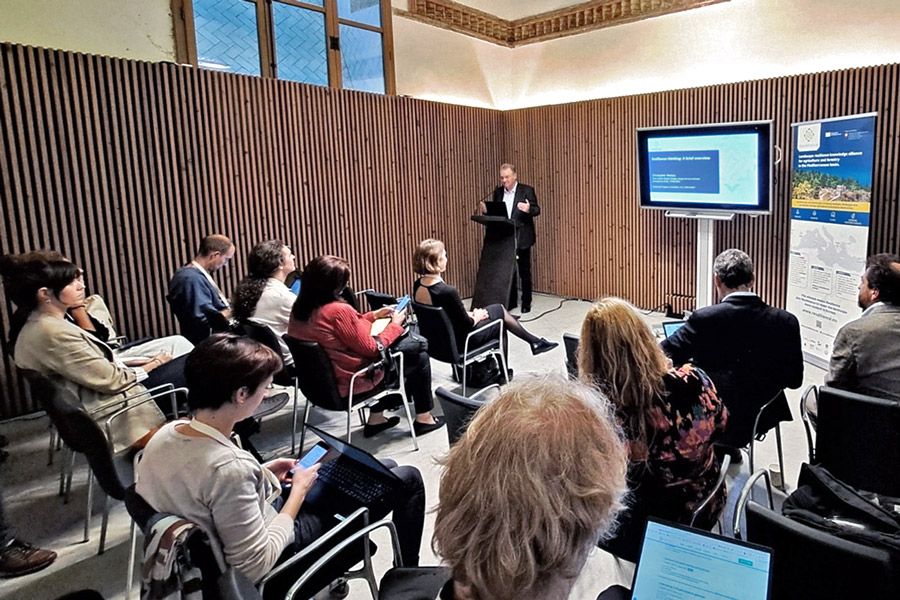
These recommendations were presented together in the ResAlliance White Paper on Mediterranean Landscape Resilience, unveiled during the project’s final policy forum in October 2025. The event brought together representatives from 31 countries, among them the Spanish Ministry of Ecological Transition, the Lebanese Ministry of Agriculture, and the Union for the Mediterranean (UfM), an intergovernmental organisation uniting 43 countries for dialogue and cooperation in the Euro-Mediterranean region. Their shared goal: to strengthen cooperation and improve the adaptive capacity of rural communities and Mediterranean ecosystems in a rapidly changing climate.
Throughout the Mediterranean region, the landscapes are as diverse as the complexity of the rules governing them. Many national, regional, and local policies are fragmented, outdated, or hard to coordinate. Political and administrative barriers slow down decision-making, while financing for nature-based solutions remains scarce or difficult to access. Innovative funding tools are emerging, but not at the scale needed. It is challenging to maintain traditional cultural landscapes, which hold both ecological and cultural value, under current economic conditions. And perhaps most fundamentally, aligning policies and best practices between EU and non-EU countries remains a steep climb, given different legal systems and governance traditions.
Addressing these intertwined ecological, economical, institutional, and financial challenges requires a coordinated transformation. During the policy forum, six key strategic directions emerged:
- Integration: Strengthening landscape resilience in the Mediterranean demands genuine cross-sector and cross-border collaboration. Persistent silos separating agriculture, forestry, water management, tourism, and finance continue to hinder progress. More robust multilevel governance, improved coordination platforms, and greater diversity of perspectives within ministries are essential to align policies and enable coordinated action.
- Sustainable management: In the EU, the CAP remains central for sustainable landscape management, but it needs revision to align better with local policies and other EU programs. Shifting from practice-based to result-based incentives and building landscape partnerships can strengthen resilience. Greater cooperation across EU initiatives can better connect farming, rural development, and nature-based solutions.
- Two-way collaboration: Effective cooperation between EU and non-EU Mediterranean countries depends on mutual learning, since many climate challenges appear first in the South and East of the basin. Shared development of solutions is key for issues like water efficiency, forest health, and wildfires.
- Digital innovation: Scaling resilience requires accessible digital tools, strong extension services, and support for women and youth innovators. While digital systems can improve climate responses, obstacles such as weak institutional coordination, complex land ownership, low trust, and low, short-term funding threaten long-term progress.
- Innovative financing: New financing models like public-social-private partnerships and payments for ecosystem services can bring in additional funding, strengthen local ownership, and reward environmental and social benefits. Regional platforms can help harmonize approaches and support long-term, collaborative nature-based solutions.
- Inclusive participation: Non-EU countries rely heavily on international cooperation to access major climate funds, but face political constraints, limited access to large mechanisms, and overlapping efforts. Better coordination among EU and non-EU actors is needed to ensure funding is demand-driven and delivers meaningful local impact.

Torre de l’Espanyol wildfire. Photo: Oriol Pellissa, Pau Costa Foundation (PCF)
This is the shift the Mediterranean now faces: moving from isolated pilot projects to policies woven into national and EU frameworks. Through its White Paper and policy dialogue, ResAlliance provides timely guidance for updates to the CAP, as well as the Green Deal’s strategies, highlighting the CAP’s key role in sustainable land use and nature-based solutions. Moreover, it encourages leveraging synergies in policies, extension services, and innovation support between EU and non-EU countries, alongside broader international cooperation. Embedding the six priorities into adaptation plans and regional mechanisms can help align actions across the Mediterranean.
Visit ResAlliance’s official website
This article was originally written by:
- Sandra Bohne – Consultant Climate Change, Energy, and Low-Carbon Development at CIFOR-ICRAF, Germany
- Christopher Martius – Senior Advisor Climate Change, Energy, and Low-Carbon Development at CIFOR-ICRAF, Germany
- Nathanaël Pingault – Senior Consultant Climate Change, Energy, and Low-Carbon Development at CIFOR-ICRAF, Germany
The post Turning local resilience solutions into lasting Mediterranean policy action appeared first on Resilience Blog.